

Can You Clean Fentanyl Off A Steering Wheel
ISMP just learned about another child that died after gaining access to a transdermal fentaNYL patch. This time information technology was a 15-month-onetime boy who had been cuddling with his female parent, sleeping on her breast as they both took a nap. The boy'south mother had been wearing a fentaNYL patch on her chest to treat pain associated with multiple sclerosis. When the female parent awoke, she found her son unresponsive. The child was rushed by ambulance to the infirmary. Resuscitation efforts connected in a pediatric emergency department without success. The kid'south mother noticed that the patch on her chest was missing. The baby manifestly ingested the patch, although the patch was never constitute. During intubation, vomitus was visualized in the baby's esophagus and trachea, indicating aspiration, and peradventure the patch was disregarded in the vomitus. A medical examiner confirmed the child'due south access to the patch, revealing physical findings of pulmonary congestion and edema, and toxicology findings of acute fentaNYL intoxication.
Repeated tragic events
Sadly, this is a recurring story in healthcare—one that has been told over and over again without substantial acknowledgement and activeness by individual practitioners, healthcare organizations and systems, community pharmacies, public policy agencies, pharmaceutical companies, professional organizations, and advocacy groups. The prior events are just every bit heartbreaking as the latest event. A ii-twelvemonth-sometime boy died afterward ingesting a used fentaNYL patch that stuck to the wheels of his toy truck while playing in his grandmother's room at a long-term care facility.1 A 1-yr-old girl swallowed a 25 mcg/hour fentaNYL patch that had been lying on the floor and was found dead but 2 hours after her parents tucked her into bed and kissed her goodnight.two Other fatalities have occurred with dislocated elderly adults and opioid-abusing teens and adults who accept chewed and/or ingested fentaNYL patches.3
Assimilation of ingested fentaNYL patches
Transdermal fentaNYL is designed to release the drug in a tedious, steady fashion over 72 hours. Merely uncontrolled quantities of the drug may be speedily absorbed via the buccal route if the patch is ingested, ofttimes with disastrous results.4 The rate of drug assimilation and severity of toxicity is dependent on the amount of time the fentaNYL patch is in direct contact with the oral mucosa and whether the patch is chewed/sucked on or swallowed intact. A patch chewed or sucked on will release large quantities of drug rapidly. Chewing is particularly unsafe because it disrupts the patch integrity and releases a full dose in a much shorter period of time than an intact patch.iii Also, fentaNYL is captivated more rapidly through buccal mucosa4 and has more than a 30-fold increment in absorption when compared to transdermal absorption.5 Swallowing an intact patch results in less rapid drug release, merely systemic absorption is still significant.2-5
Given that each patch holds a relatively large dose of fentaNYL, and that about half of the full drug corporeality remains in a patch after 3 days of employ,ii chewing or sucking on a patch—even a used one—can result in a big overdose. Faust et al.3 provides the post-obit case. A 50 mcg/60 minutes patch the authors tested held nearly eight,400 mcg of fentaNYL (the actual amount varies depending on design of the patch). If the patch in this example and its entire contents were ingested intact, virtually one,680 mcg would enter the systemic apportionment. If the entire contents of the patch were removed (past chewing, for case) and absorbed buccally, the dose inbound the apportionment would exist most 3 times higher (about 5,000 mcg) than swallowing the patch intact.iii
Other fentaNYL patch tragedies
Children have as well been victims of fatal fentaNYL overdoses later they applied a patch intended for an adult to their skin. A 4-year-sometime kid died after finding a used fentaNYL patch in a trashcan and placing it on his body like a Rough-and-tumble.6 An uninformed mother placed a fentaNYL patch, which had been prescribed for the female parent after a car accident, on her 6-year-erstwhile daughter'due south neck when the immature child complained of neck hurting before going to bed; the child was found expressionless the adjacent morning. The US Food and Drug Administration (FDA) evaluated 26 cases of pediatric adventitious exposures to fentaNYL patches reported during the past fifteen years.vii Of these, 10 resulted in death and 12 in hospitalization. Sixteen of the 26 cases occurred in children 2 years old or younger. The mobility and marvel of young children provide ample opportunity to find fallen patches, improperly discarded patches, or improperly stored patches.
Opioid-naïve adults accept likewise fared poorly when prescribed fentaNYL patches inappropriately for astute pain or when instructions for use were not provided and understood. For example, an otherwise salubrious opioid-naïve 47-year-one-time homo died one day later on discharge from a hospital where he was given a prescription for fentaNYL patches for post-operative pain following spinal surgery.8 A 77-year-quondam adult female was plant expressionless at habitation with multiple fentaNYL patches on her body and a heating pad over one of the patches.9
Impetus for change
Can you imagine the grief of the parents who constitute their lifeless children, or the family members who lost their loved ones to this preventable outcome? Healthcare professionals typically exhibit profound empathy for those who suffer such a loss, but non all may feel personally responsible to prevent these events. What if y'all were the dr. who prescribed a fentaNYL patch that led to a fatal outcome, or a community chemist who dispensed the patch involved in a fatal result, or the nurse who discharged a patient from the infirmary with a prescription for a fentaNYL patch that ultimately resulted in such a tragedy? Must it take personal interest in an actual event for all individuals to feel the weight of these fatal errors and incite preventive action?
Bystander aloofness
Until each and every healthcare professional, wellness system, community pharmacy, pharmaceutical company, public policy agency, and professional arrangement potentially associated with fentaNYL patches and the patients who use them accept personal responsibility for promoting safe utilise of this powerful opioid, nosotros are exposing one of the almost troubling examples of eyewitness apathy in healthcare.
Eyewitness aloofness is not caused by an indifference to patient laziness, apathy, or lack of concern for patients, but rather by a belief that others in a group who see the same risks volition intervene.10 Studies take shown that people are less likely to intervene when other people are also able to help.10 When groups of people are involved, the responsibility to act is lengthened rather than personal. We tin can easily convince ourselves that our personal action is not needed. Perhaps someone else more qualified will have care of the problem or address the issue. The sad truth is, nosotros are all complicit if we continue to permit these tragic, preventable events to happen.
Preventing fentaNYL patch tragedies
The prescribing physician and the discharging nurse cannot just rely on each other or a hospital/community pharmacist to verify the appropriateness of fentaNYL patches and doses, or to educate patients about important risks and proper employ. The hospital/community pharmacist cannot just assume the drug and dose is appropriate or that the patient has been educated. All healthcare providers must individually instruct patients and caregivers nigh proper apply and risks. Professional associations that back up physicians, pharmacists, and nurses cannot remain silent on this important issue. Safety organizations, including ISMP, need to pace up efforts to make fentaNYL patch safety among the highest priorities. Pharmaceutical companies tin can no longer sidestep improved label warnings, neglect to provide secure disposal containers for patches, or ignore further exploration of steps to prevent misuse and errors, such as making the patch wholly unpalatable. Professional licensing agencies and accrediting organizations demand to ready standards regarding patient education that specifically accost the risks associated with fentaNYL patches. The FDA needs to expand its Hazard Evaluation and Mitigation Strategies (REMS) for long-acting opioids to include required patient pedagogy by prescribers, pharmacists, and nurses, and the agency needs proper legislative authority to require prescriber education or perhaps a special restricted distribution plan for the drug. This time around, nosotros hope organized groups that correspond chemist's shop chains, pharmacy boards, and pharmacy practice will support expansion of the REMS to include pharmacists in consumer educational activity for long-acting opioids, including fentaNYL patches.
Focused educational activity
Patients who are using a fentaNYL patch, or their caregivers, need to know most proper apply, storage, and disposal, and other risks, especially when using the patches around children. To assist, ISMP has developed a Gratis patient education checklist and consumer leaflet for apply during consumer instruction that tin then be given to the patient for reference (download the checklist/leaflet below). The checklist/ leaflet includes, among other important information, 10 key safety tips for consumers using fentaNYL patches (safety tips listed in Table 1).
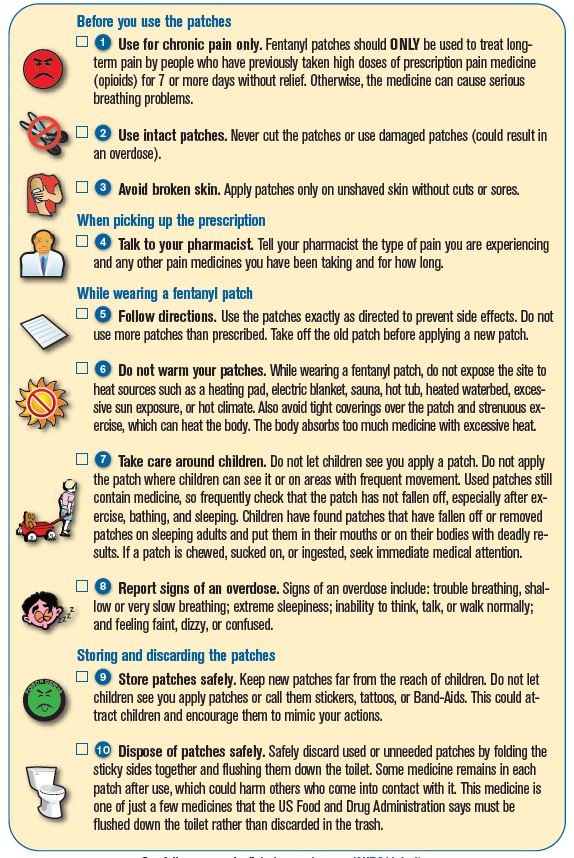
FDA too requires a Medication Guide to be given to patients, and the bureau has developed a Safe Use Initiative around proper disposal of the patches. Information technology'south one thing to tell people to read these materials and hope that they do; information technology'southward quite another to accept personal responsibility for providing this education to patients face-to-face.
No patient should always be allowed to walk out of a doctor'southward office, hospital, clinic, or pharmacy without contiguous instructions on the apply of fentaNYL patches and related safety concerns, besides as verification of consumer understanding. Everyone must accept responsibility and never assume someone else will act. The modify necessary to improve patient condom will always depend on individuals who, never satisfied with being a eyewitness, are fatigued into the lifesaving work of keeping patients rubber from harm. Widespread adoption of required consumer education will also exist more effective if influential groups work together and if external forces provide the necessary pressure via regulations, standards, public policy, or incentives.

Can You Clean Fentanyl Off A Steering Wheel,
Source: https://www.ismp.org/resources/fentanyl-patch-fatalities-linked-bystander-apathy-we-all-have-role-prevention
Posted by: cummingsbuiting.blogspot.com
0 Response to "Can You Clean Fentanyl Off A Steering Wheel"
Post a Comment